What Is a Virtual Office? Complete Guide for Remote Teams
Let’s look at what a virtual office platform actually is, how it works, real pricing, and how to choose one for a remote or hybrid team in 2026.
TL;DR
- "Virtual office" has two different meanings: a business mailing address service, and virtual office software for remote teams. This guide covers the second one.
- Virtual office software gives distributed teams a persistent digital space to work, meet, and run into each other, without scheduling every interaction.
- Pricing ranges from free tiers for small teams to $20-25/user/month for enterprise plans.
- Hybrid work has stabilized at roughly half of remote-capable US employees, even as some companies push return-to-office policies in 2026.
- The right platform depends on team size and whether you need AI-driven coordination, playful social presence, or an enterprise floor-plan layer.
If you searched "what is a virtual office space," you might actually be looking for a business mailing address service, mail handling, a receptionist, meeting rooms by the hour. That's a real, different product category, and this guide isn't about it.
This guide covers the other meaning: virtual office software, a digital workspace where remote and hybrid teams gather, talk, and collaborate as if they shared a building.
Gallup and Robert Half's 2026 workforce data show hybrid work has stabilized at 52% of remote-capable US employees, even as many companies now push for a full office return.
That tension is exactly why this category exists: a distributed team still needs somewhere to feel like a team.
What Is a Virtual Office? (Two Different Meanings)
Traditional virtual office: A business service providing a professional mailing address, mail handling, and sometimes a receptionist or meeting room access, for companies that don't want to lease physical office space. Providers include WeWork, Regus, and iPostal1.
Virtual office software: A digital platform where remote or hybrid teams work, meet, and interact throughout the day, replacing the physical office as the place work happens. This is the category covered in the rest of this guide.
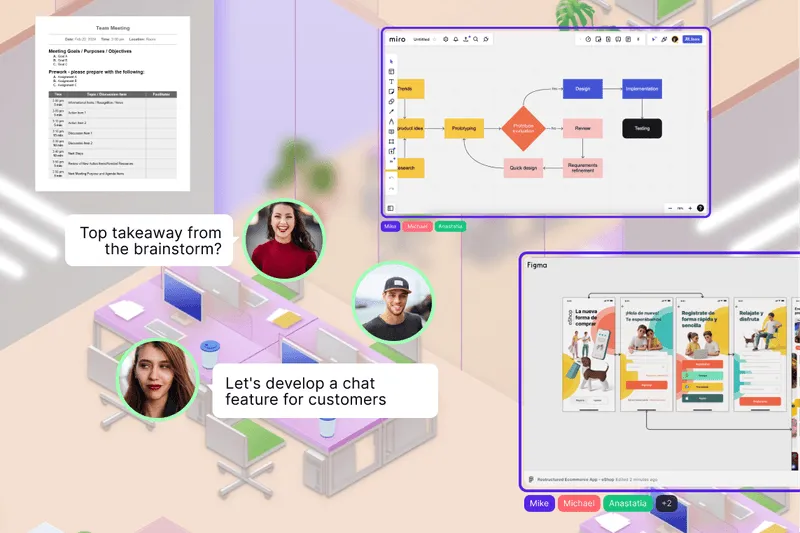
The two share a name because both replace something a physical office used to provide, an address in one case, a shared virtual office space in the other. They solve completely different problems and aren't interchangeable.
How Virtual Office Software Actually Works
Instead of scheduling every interaction as a calendar event, virtual office software gives a team a persistent digital space they can drop into. Most virtual office platforms share a similar structure:
- A shared virtual space, sometimes a literal floor plan, sometimes a more abstract set of rooms
- Presence indicators showing who's currently "in," similar to seeing an occupied desk
- One-click or walk-up audio and video, no meeting link required
- Persistent rooms for specific functions: focus work, team huddles, all-hands
- Async elements like chat and shared boards that persist between sessions
Here’s a practical guide on how to select the right virtual office platform in 2026.
The core idea is proximity replacing scheduling. Instead of booking a call to ask a quick question, you see someone's available and start talking, closer to tapping a colleague on the shoulder than sending a calendar invite.
A February 2026 SurveyMonkey study of 3,581 US workers found that nearly four in ten say their ideal work arrangement has shifted since the pandemic. That's a reminder that the tools teams use for daily presence matter as preferences keep changing.
Core Features of a Virtual Office Platform
A few features consistently separate a genuinely useful virtual office platform from a glorified video call:
- Persistent, branded rooms that stay set up between sessions, not a fresh link every time
- Presence and status visibility, so teammates know who's actually around
- Spatial or proximity audio in some platforms, where volume changes based on how close you are to someone
- Built-in collaboration tools like whiteboards and shared documents, embedded rather than tab-switched
- Analytics on usage and engagement, useful for distributed teams trying to gauge actual connection
- Single sign-on and admin controls for larger organizations
Not every platform needs every feature. A 10-person startup and a 500-person enterprise are optimizing for different things entirely. SpatialChat's own analytics dashboard is a useful example of what usage tracking actually looks like day to day.
What Virtual Office Software Costs
Pricing varies by platform philosophy as much as by scale:
- Budget/AI-driven tools: roughly $6-15/user/month, often with a limited free tier for small teams
- Playful/spatial platforms: $12-20/user/month, several removed free tiers in 2025-2026
- Enterprise floor-plan platforms: $15-25/seat/month, sometimes with seat minimums for larger plans
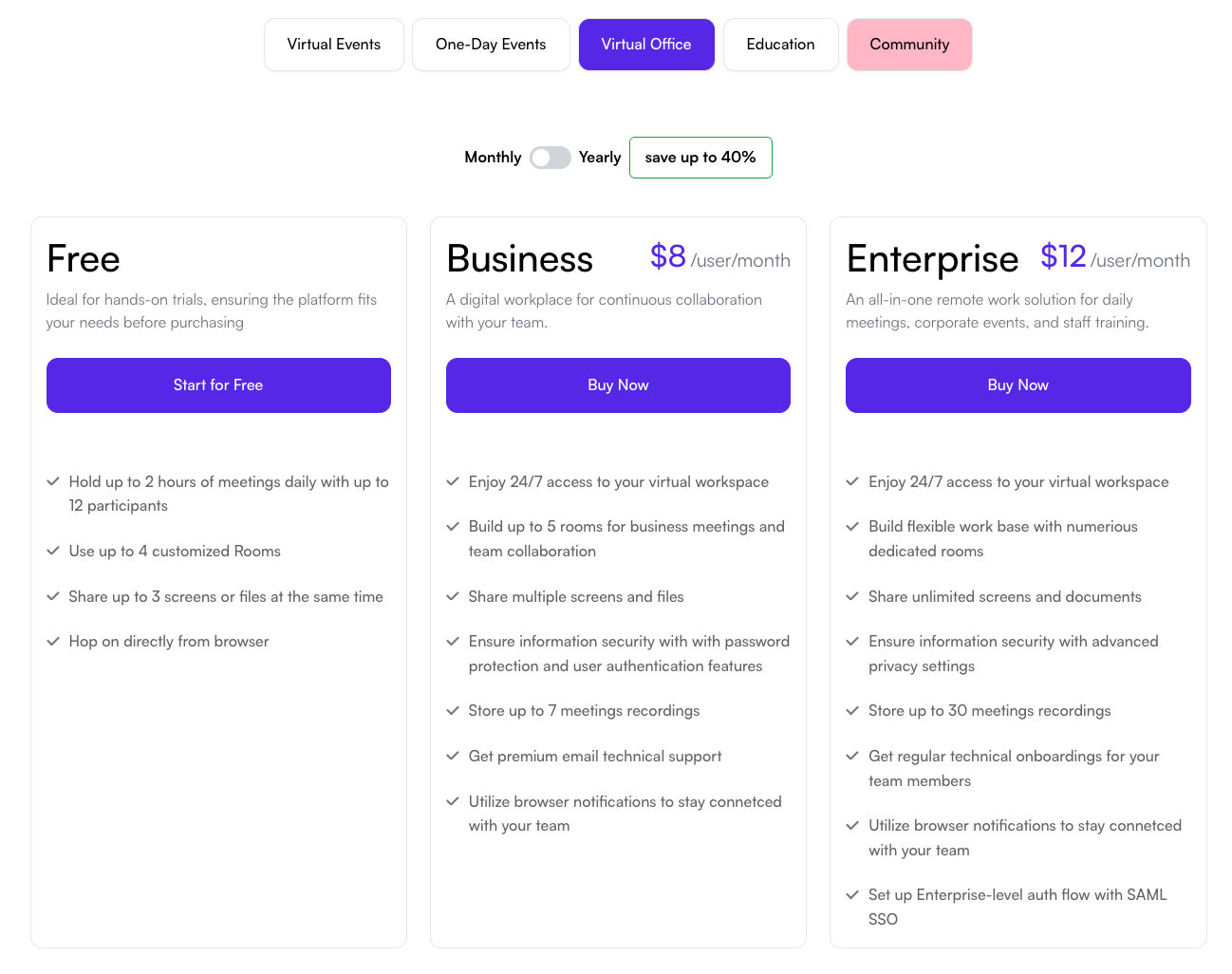
Free tiers exist across most of the category but usually cap out around 10-25 users, enough to trial the product, not run a full company indefinitely.
Annual billing typically saves 10-20% over monthly. See SpatialChat's own pricing for a real example of how a free tier and paid plans scale together.
Top Virtual Office Platforms to Know
A quick snapshot of platforms worth evaluating, each built around a different philosophy:
- SpatialChat (spatial audio, flexible for both daily work and events): free tier available, paid plans scale by team size. Proximity audio and persistent branded rooms built for both everyday coworking and larger gatherings.
- SoWork (AI-driven coordination): $6-15/user/month, free tier for up to 10 users. Built around AI meeting notes and reducing context-switching for distributed teams.
- Gather (playful, pixel-art social presence): $12-15/user/month after removing its free tier in 2025. Strongest for teams prioritizing a fun, game-like culture over deep AI tooling.
- Sococo (enterprise floor-plan presence): $15-25/seat/month with seat minimums on larger plans. Built as a visibility layer on top of existing tools like Zoom or Webex rather than replacing them.
None of these is the universal best option. The right pick depends on whether your priority is AI-assisted coordination, social culture, enterprise control, or flexibility between daily work and events.
How to Choose the Right Platform for Your Team
Match the platform to how your team actually works, not to whichever tool has the flashiest demo:
- For a small team wanting spontaneous, drop-in conversation, prioritize ease of walking up to a colleague over admin complexity.
- For a distributed team(which might include virtual onboarding) that also runs occasional larger gatherings (all-hands, events), look for a platform flexible enough to handle both, not two separate tools.
- For an enterprise team already invested in Zoom or Webex, a presence layer that sits on top of existing infrastructure avoids a disruptive full replacement.
- For a culture-first team, weigh how customizable and playful the space actually feels, since adoption depends on people wanting to open it.
Trial it with a real subset of your team before rolling out company-wide. A tool that looks great in a sales demo can still fail if your team simply doesn't open it during a normal workday.
If your team splits time between home and a physical office, the shift to hybrid workspace covers that specific balance in more depth.
Common Mistakes to Avoid
A few mistakes come up repeatedly when teams adopt virtual office software:
- Rolling out to the whole company at once, without a trial group testing daily habits first
- Choosing based on visual polish alone, without checking whether it actually reduces meeting overhead
- Ignoring your team's existing tool stack, then fighting friction with a platform that doesn't integrate
- Treating the virtual office as mandatory always-on presence, which breeds resentment instead of connection
- Skipping a clear "how we use this" guide, so adoption depends entirely on individual habits
Most of these are cultural, not technical. The tool rarely fails on its own; unclear expectations around how to use it usually does. For one specific format worth getting right, see pro tips to hold productive virtual 1:1s.
How SpatialChat Approaches the Virtual Office
SpatialChat is built around proximity instead of scheduling. Teams move freely between focus areas and collaboration zones, and spatial audio recreates how conversations start and stop in a real room: walk closer to join, step away to leave.
Where SpatialChat differs from most single-purpose tools is flexibility: the same space that hosts daily coworking can also host an all-hands or larger event.
See 8 creative meeting formats your remote team can try for how that plays out day to day, and selecting the right virtual office platform for the broader tradeoffs.
Try SpatialChat's virtual office software free to see how proximity-based presence feels in practice.
Conclusion
A virtual office isn't one thing, and confirming which meaning you're actually looking for is worth the first thirty seconds of research. For remote and hybrid teams, virtual office software solves a real problem: staying connected without turning every interaction into a scheduled call.
Hybrid work has stabilized, not disappeared, even with real return-to-office pressure in 2026.
Teams that invest in a space designed for spontaneous connection tend to need fewer scheduled meetings to accomplish the same thing.
Try SpatialChat free to see what that looks like for your team.
FAQ
Is a virtual office the same as a business mailing address service?
No, though they share a name. A business mailing address service provides a professional address and mail handling. Virtual office software is a digital workspace for remote teams to meet and collaborate, an entirely different product category.
Do I need virtual office software if my team already uses Slack and Zoom?
Often yes, since Slack and Zoom solve different problems: async messaging and scheduled calls, not spontaneous, drop-in presence. Virtual office software fills the gap between the two, where a quick question doesn't need a calendar invite.
How many people does a virtual office platform work for?
Most platforms work well from small teams of 5-10 up through several hundred, though the right choice shifts with size. Very small teams often do fine on a free tier, while large enterprises usually need admin controls and SSO on a paid plan.
Can a virtual office platform replace all-hands meetings and town halls?
Some can. Platforms with persistent, larger-capacity rooms handle both daily coworking and bigger gatherings in one space. Others are built strictly for small-group daily use and need a separate event tool for large meetings.
What's the difference between a virtual office and a project management tool?
A virtual office is about presence and real-time interaction, seeing who's around and talking to them instantly. A project management tool tracks tasks and deadlines asynchronously. Most teams use both together, not one instead of the other.
Do virtual office platforms work for hybrid teams, not just fully remote ones?
Yes, and hybrid teams are often the better fit, since in-office and remote employees can join the same space rather than remote workers watching in-person meetings from outside. This is one of the fastest-growing use cases as hybrid work stabilizes.
Is there a free virtual office platform?
Several platforms offer free tiers, typically capped around 10-25 users. They're usually enough to trial the product with a small team, but most companies outgrow the free tier once they roll out company-wide.
How long does it take a team to actually adopt a virtual office platform?
It varies, but teams that trial with a small group first and set clear usage norms tend to see real adoption within a few weeks. Company-wide rollouts without a trial phase often stall, since habits don't form without a clear "how we use this" expectation.
Does spatial audio actually matter, or is it a gimmick?
It's a real differentiator for some teams and irrelevant for others. Spatial audio recreates the feeling of overhearing nearby conversations and choosing whether to join, which matters most for teams that value spontaneous, organic interaction over structured meetings.
Can a virtual office platform integrate with tools like Google Workspace or Microsoft 365?
Many do, through embedded documents, calendar sync, or SSO, though integration depth varies significantly by platform. Confirm the specific integrations you need are live, not just planned, before committing.