What Are the Features to Look for in Virtual Classroom Software
A buyer's checklist for virtual classroom software: video quality, breakout rooms, integrations, analytics, security, and what actually matters.
TL;DR
- Most feature checklists list the same items: video, chat, breakout rooms, recording. Those describe a meeting tool, not a learning environment.
- What actually separates platforms is how a feature works, not whether it exists, especially for breakout rooms and analytics.
- US organizations spent $102.8 billion on training in 2025, and ATD Research has found virtual instructor-led classrooms increasingly used specifically to cut costs.
- Security, LMS integration, and device compatibility matter more once you're rolling a platform out beyond a single class.
- Test any platform with your actual class size and format before committing, not just a features list on a sales page.
Every virtual classroom software comparison reads roughly the same: video conferencing, screen sharing, chat, breakout rooms, recording. If you've read three of these lists, you've read all of them, and none of it tells you which platform is actually right for teaching.
US organizations spent $102.8 billion on training in 2025, up from $98 billion the year before. Separately, ATD Research has found that virtual instructor-led classrooms are increasingly used specifically because they reduce instructor travel costs.
That's real money riding on picking the right platform, and this guide breaks down what to actually evaluate, feature by feature.
Why a Feature Checklist Alone Isn't Enough
Nearly every virtual classroom platform on the market has breakout rooms, polls, and a whiteboard. Listing those features tells you almost nothing, since the box gets checked either way. What actually matters is implementation.
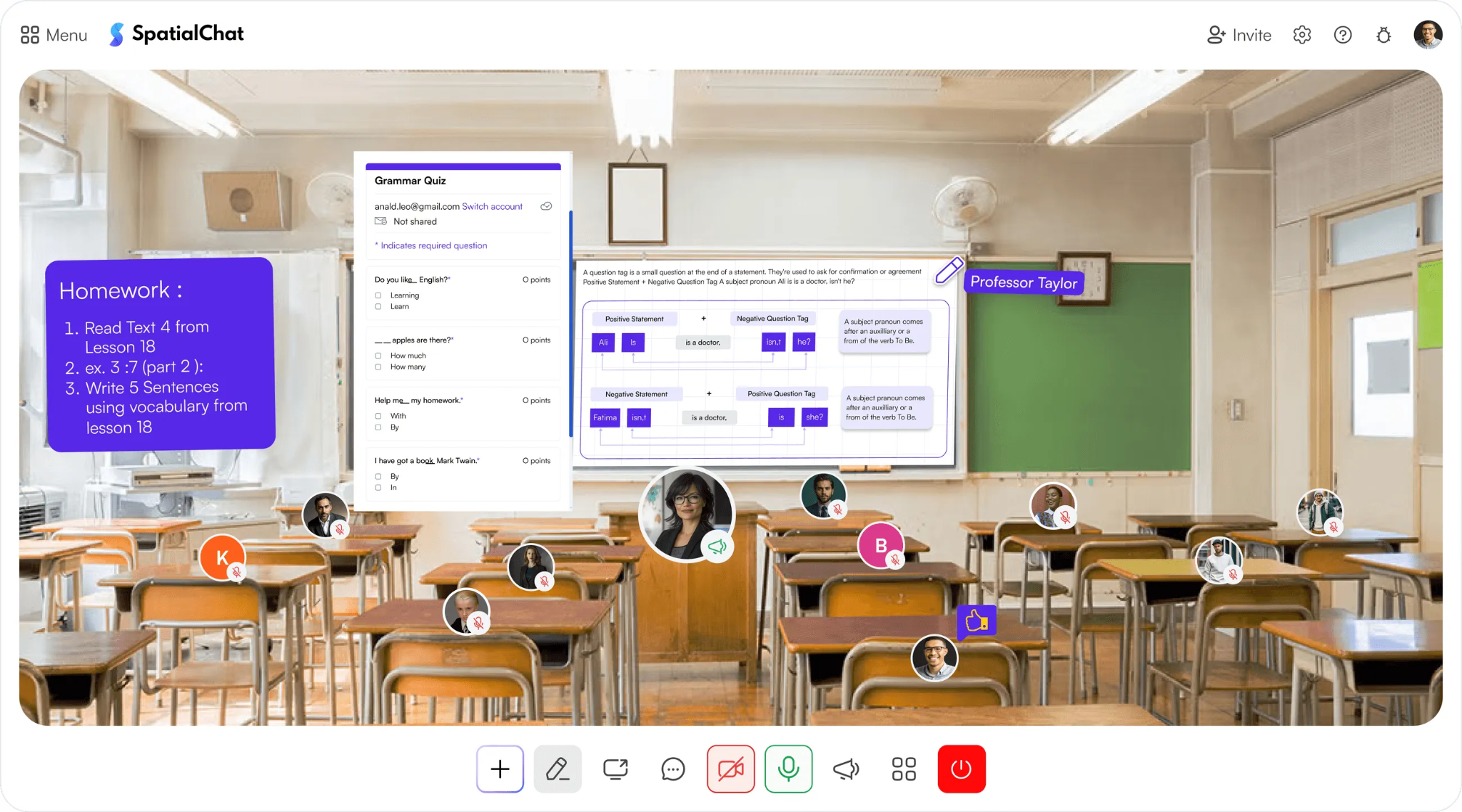
Breakout rooms are the clearest example: on many platforms, they're temporary, a facilitator manually assigns groups, rebuilds them for the next activity, and repeats that setup every single session. On others, groups persist across sessions with no manual rebuilding required. Evaluate every feature on this list the same way, not "does it exist," but "how does it actually work when you use it."
1. Spatial Audio Is Where Video and Audio Quality Actually Differ
Video and audio are the baseline, but quality and format vary more than most buyers expect:
- Reliable video and audio at your actual class size, tested under real conditions, not a sales demo with five people.
- Spatial or proximity audio, where volume changes based on distance in a shared space, on platforms built around movement rather than a static grid.
- Screen sharing and multi-screen support, so more than one presenter or resource can be visible at once.
- Recording quality, since a recording that's hard to follow defeats the purpose of capturing the session.
Static video-grid platforms handle basic video and audio fine. Spatial audio is where the differentiation actually shows up, and it's worth testing directly rather than taking a feature list's word for it.
2. Breakout Rooms Are Where Platforms Differ Most
This is the single feature most worth scrutinizing closely, since the gap between platforms is largest here:
- Persistent vs. ad-hoc groups: do students return to the same small group automatically, or does the teacher reassign manually every time?
- Time to set up: how many clicks and how much manual work does forming groups actually take?
- Teacher visibility into groups: can the instructor see which groups are active and drop in without disrupting the room?
- Group size flexibility: can groups range from a pair to a dozen depending on the activity?
Ad-hoc, manually-assigned breakout rooms eat real class time. Across a semester, minutes spent rebuilding groups every session compound into hours that could've gone to actual teaching.
3. The Engagement Features That Actually Keep Students Present
Beyond breakout rooms, a handful of engagement features consistently matter:
- Polls and quizzes, ideally built in rather than requiring a separate tool
- Live Q&A and hand-raising, so quieter students have a clear way to signal a question
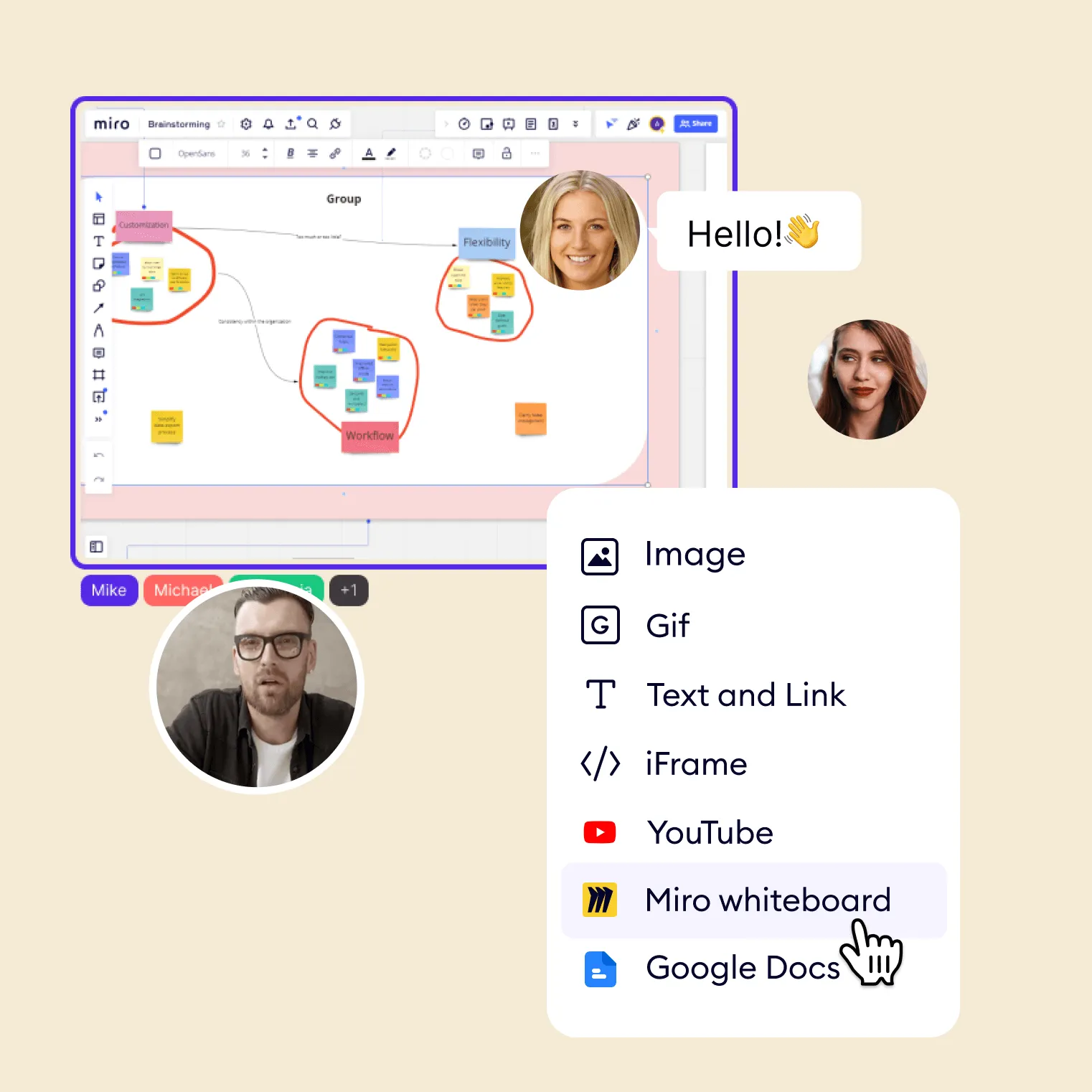
- Embedded whiteboards and shared documents, without switching tabs or opening a separate app
- Reactions and informal chat, for the kind of quick, low-stakes participation a formal question doesn't cover
None of these individually make or break a platform, but together they determine whether a class feels interactive or just supervised.
4. Integrations and Analytics Matter Once You're Managing More Than One Class
For any classroom beyond a single teacher's single class, integrations and data matter:
- LMS integration, especially with Canvas, Moodle, or Blackboard, so grades and rosters don't require manual syncing
- Attendance and participation analytics, ideally built into a dashboard rather than requiring manual export
- Content integrations, like Google Drive or Miro, so materials live in one place instead of scattered across tabs
The virtual advantage of a connected learning ecosystem comes specifically from these integrations working together, not from any single one in isolation.
5. Security Requirements Scale With Institution Size
Security requirements scale with institution size and student age, but a few basics apply everywhere:
- Encryption and data handling that meets your institution's or district's requirements
- Access controls, so only enrolled students can join a session
- Role-based permissions, distinguishing what a teacher, a TA, and a student can each do
- Compliance certifications relevant to your sector, like FERPA for US education
Don't assume a platform meets your requirements just because it's popular. Confirm the specific certifications and controls you need are actually in place.
6. Ease of Use and Pricing: The Overlooked Factor in Long-Term Adoption
The best feature set means nothing if people don't actually use it or the pricing is not suitable:
- Browser-based access, so students and teachers aren't blocked by downloads or IT approval
- A short learning curve for both teachers and students, ideally usable within one session
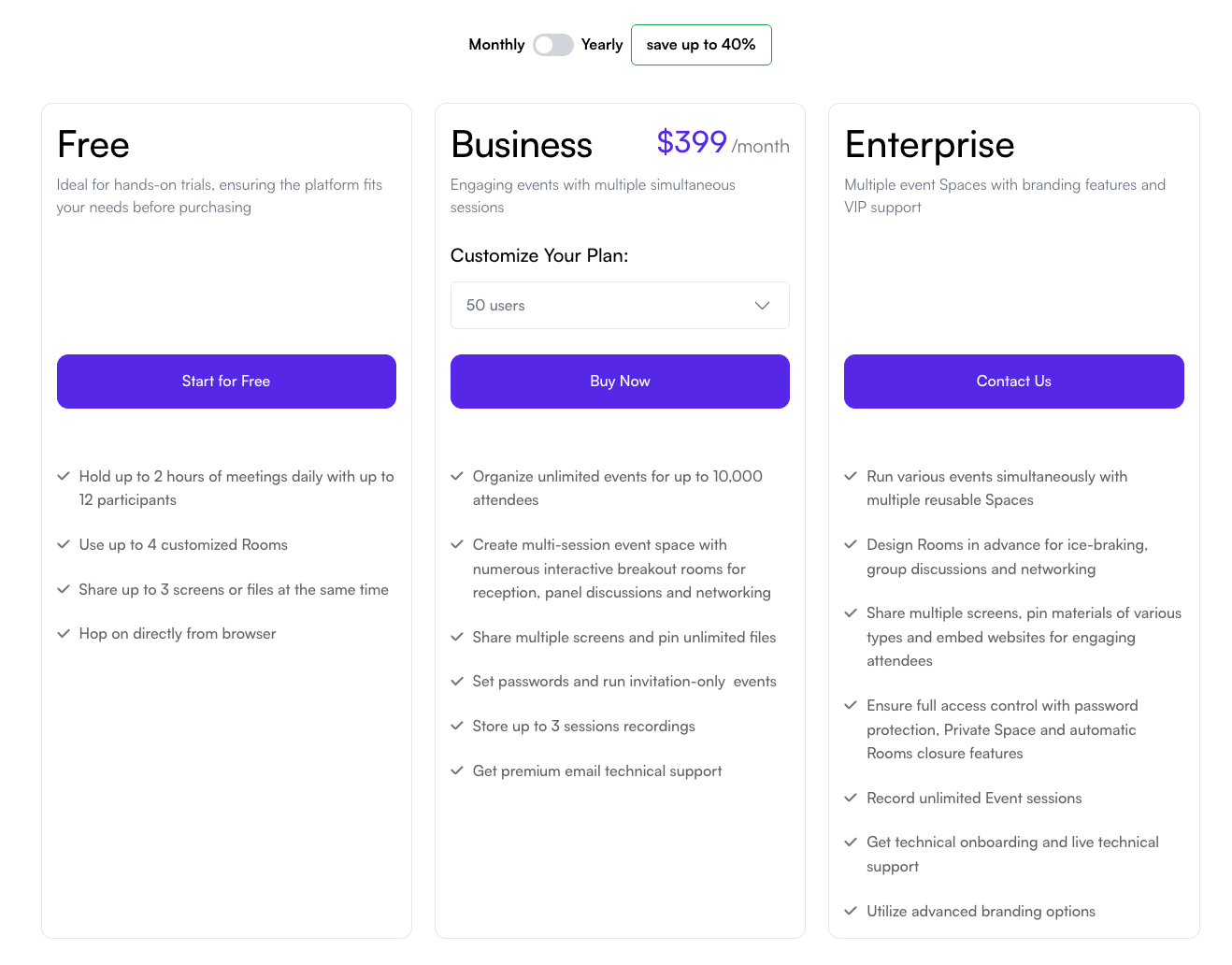
- Transparent pricing, scaling clearly by class size or seat count rather than hidden behind a sales call
- A usable free tier or trial, so you can test before committing budget
A platform your team actually opens every day beats one with more features that stays unused after week two.
How to Actually Evaluate a Platform
Move past the feature list and test directly:
- Run a real session, not a sales demo, with your actual class size and format.
- Time the setup, especially for breakout groups, to see how much manual work repeats every session.
- Check the analytics dashboard yourself, rather than trusting a screenshot in a sales deck.
- Confirm integrations are live, not listed as a future roadmap item.
- Ask current customers, not just the vendor, how the platform holds up over a full semester or term.
Setting up your first virtual classroom walks through this evaluation process in more practical detail once you've narrowed your options.
How SpatialChat Delivers on These Features
SpatialChat was built around the features that separate a real learning environment from a meeting tool with a different label. Spatial audio recreates real-room conversation instead of a static grid, and breakout groups can persist across sessions rather than resetting every class.
On integrations and data, SpatialChat connects to Canvas LMS, embeds tools like Miro and Google Slides, and includes SAML SSO with a built-in analytics dashboard.
Scaling corporate training with virtual events shows how these same features extend to organization-wide training.
See our complete guide to virtual classroom best practices for the fuller picture, or try SpatialChat's virtual education platform free to test these features against your own class.
Conclusion
A feature checklist is a starting point, not a decision. Every platform on the market can claim breakout rooms, polls, and integrations; what actually matters is whether those features hold up under your specific class size, subject, and teaching style.
Test the features that matter most to you directly, especially breakout room setup time and analytics, before committing budget or migrating a full course.
The right software should reduce the manual work of teaching, not just add another feature to the list.
FAQ
What's the most important feature in virtual classroom software?
There's no single answer, but breakout room implementation is where platforms differ most. Persistent, low-friction groups save real class time compared to platforms requiring manual reassignment every session.
Do I need LMS integration if I only teach one class?
Probably not urgently. LMS integration matters most once you're managing rosters, grades, or multiple sections, where manual syncing between systems becomes genuinely time-consuming rather than a minor inconvenience.
Is spatial audio actually necessary, or is a regular video grid enough?
A regular grid works fine for lecture-style delivery, where one person mostly talks. Spatial audio matters more for discussion-heavy or small-group formats, where natural, overlapping conversation is actually the point of the session.
How important are analytics for a single teacher, versus an institution?
For a single teacher, basic attendance data is usually enough. Institutions managing many sections benefit far more from detailed analytics, since they need to compare engagement and outcomes across classes.
Should I prioritize price or features when choosing virtual classroom software?
Neither in isolation. Match the feature set to what you'll actually use regularly, then compare pricing across platforms that already meet those specific needs, rather than starting with price alone.
What security certifications should I look for?
FERPA compliance matters for US education specifically, alongside standard encryption and access controls. Ask directly whether a platform holds the certifications relevant to your institution rather than assuming based on popularity.
Can I test these features before committing to a paid plan?
Most platforms, including SpatialChat, offer a free tier or trial specifically for this. Use it to test breakout rooms, integrations, and analytics with real class conditions, not just a quick tour.
Do these features matter differently for K-12 versus higher education?
Somewhat. K-12 tends to prioritize security, access control, and ease of use for younger students, while higher education often weighs LMS integration and analytics more heavily across larger course loads.
How do I know if a feature is genuinely useful or just marketing?
Test it directly rather than reading a feature description. A feature that takes five extra clicks to use every session will quietly go unused, regardless of how it's marketed.
What's the difference between a feature checklist and a real evaluation?
A checklist confirms a feature exists. A real evaluation tests how it performs at your actual class size and times the setup. It also confirms integrations are live rather than planned, which is what predicts whether a platform actually gets used.