
At the University of Michigan, innovation doesn’t live in silos. It thrives at the intersection of research, collaboration, and real-world impact. One of the clearest examples of this is how the University of Michigan’s Biomedical Engineering (BME) department uses SpatialChat to bring together researchers, industry partners, and athletic stakeholders in a shared virtual environment designed for meaningful connection.
From advancing athlete safety to shaping the future of medical devices, the BME team relies on SpatialChat to support collaboration that goes beyond traditional video conferencing.
A Virtual Space Built for Research Collaboration
Biomedical engineering work is inherently collaborative. Researchers need room to exchange ideas, discuss prototypes, review findings, and connect with external partners in ways that feel natural and dynamic.
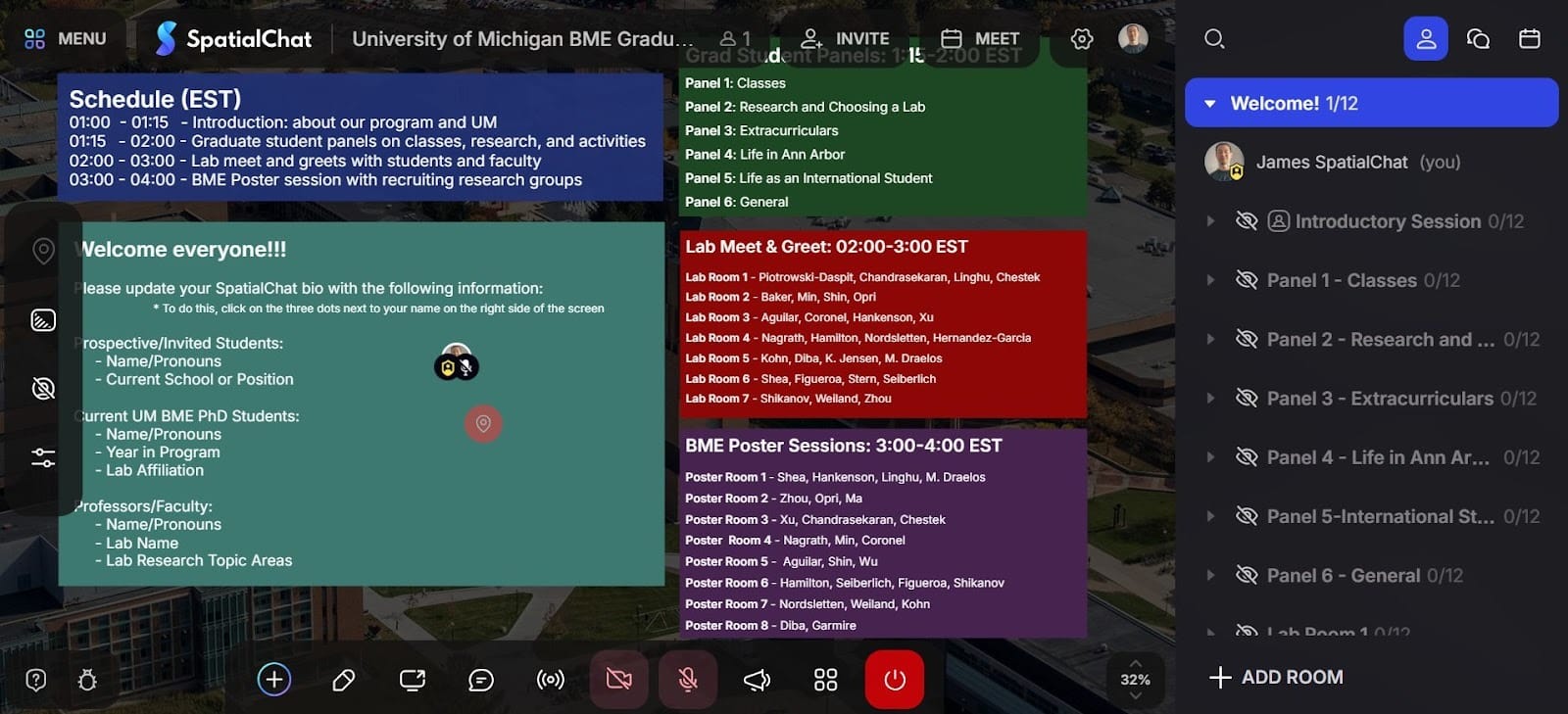
SpatialChat provides the University of Michigan BME community with a virtual space that mirrors the spontaneity of in-person interaction. Instead of rigid meeting grids, participants move freely through the space, engaging in small-group conversations, side discussions, and focused breakout sessions, all within the same environment.
This spatial format makes it easier for faculty, researchers, students, and collaborators to interact organically, whether they’re discussing early-stage research or exploring real-world applications of biomedical innovation.
Supporting Athlete Safety Through Engineering Innovation
A key area of focus for the University of Michigan’s Biomedical Engineering department is athlete health and safety. The team works closely with the university’s football program, applying engineering expertise to help reduce injury risk and improve long-term outcomes for athletes.
Through collaborative sessions hosted on SpatialChat, researchers and partners explore initiatives such as:
- Developing safer helmet technologies aimed at reducing the risk of CTE
- Designing advanced padding and protective equipment
- Improving training procedures and injury-prevention methodologies
- Innovating medical devices with applications that extend well beyond athletics
By using SpatialChat as a collaboration hub, these conversations can happen more frequently and more inclusively without the constraints of physical location.
Connecting Academia, Athletics, and Industry
One of the strengths of the University of Michigan BME program is its ability to connect academic research with practical implementation. SpatialChat plays a central role in enabling these connections.
Virtual receptions, research showcases, and partner meetings hosted on SpatialChat allow:
- Industry collaborators to engage directly with researchers
- Students to present work in an interactive setting
- Cross-disciplinary teams to form and evolve in real time
Because SpatialChat supports multiple conversation zones within a single space, participants can move seamlessly between discussions, thereby replicating the experience of walking through a physical research reception or networking event.
A More Human Virtual Experience
For a department focused on human health and performance, the way people connect matters. SpatialChat’s proximity-based audio and video create a more intuitive, human-centred virtual experience compared to traditional meeting tools.
Instead of scheduled turn-taking, conversations unfold naturally. This makes SpatialChat particularly well-suited for:
- Research discussions that benefit from spontaneous input
- Informal networking between faculty, students, and partners
- Ongoing collaboration with athletic and medical stakeholders
The result is a virtual environment that supports both structured research dialogue and unplanned moments of discovery.
Advancing Research With Purpose
The University of Michigan’s Biomedical Engineering department continues to lead with purpose by advancing research that improves athlete safety, informs better training practices, and drives medical innovation across industries. By using SpatialChat as a core collaboration platform, the team ensures that critical conversations remain accessible, engaging, and impactful. It’s a powerful example of how the right virtual environment can support serious research, meaningful partnerships, and real-world outcomes.
SpatialChat is proud to support the University of Michigan Biomedical Engineering community as they continue to push the boundaries of engineering, medicine, and human performance — together, in a space designed for collaboration.